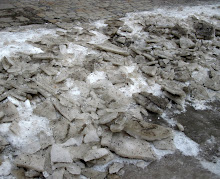
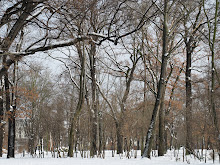
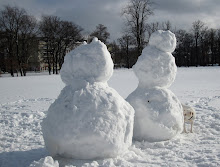
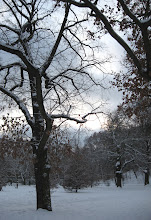
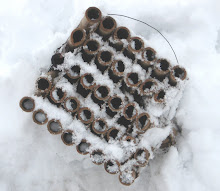
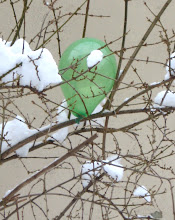
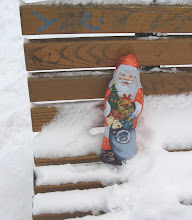
We had a VERY cold week last week, between 7 and 10 degrees most days, with an occasional high of 12. It snowed first so the white has stayed put pretty well until today, when suddenly it has been almost 40 and I don't really need the extra-warm hat and slightly warmer dog-park coat I just bought. There is still a lot of winter to get through, though, so I'm sure I'll get my money's worth by March.
This clearly did not turn out to be the daily disciplined writing I had hoped for, but the days have begun to blend together and move so rapidly it has gotten hard to keep track of what I've done. I have been to a lot of museums: the Pergamon, the Neues Museum, the Altes Museum, the Neue Nationalgalerie, the Alte Nationalgalerie, the Bode, the Guggenheim, the Berlinishe Galerie, the Dali Museum, the Illustrators Forum, the Berggruen, the Bröhan, the Hamburg Banhof, the Kunstgewerbemuseum, some of them multiple times by now. I've also spent a lot of hours at the Volkspark walking Maggie and hanging out at the Hundplatz, getting impromptu German lessons and making acquaintances of dogs and people alike. And then there have been the Christmas markets and concerts I've been attending lately.
The third concert, on Sunday afternoon, was not what I expected. For one thing it wasn't in the Dom itself, but in one of the separate chapels which could have doubled as a meat locker it was so cold. I got a front row seat, but that didn't matter as the choir, the Capella Cantorum Berlin, performed in a loft where nobody could see them. The 300-year-old Italian organ was also in the loft, so nobody could see it either. What I was left looking at were a couple of huge and quite ghastly religious paintings, one of the Pentecost I think, as the altar piece, and one other mumbly composition with lots of rolling eyeballs, gesticulating digits and stiffly floating drapery off to one side. There was a vast quantity of liver-colored marble as well, in the huge columns supporting the ceiling and in the altar itself. Maybe not my favorite stone.
The 17th-century Northern German music would have been lovely if the basic a cappella men's choir had been left alone to do its thing, but someone's misplaced zeal mandated the addition of a boys' choir to the mix. We know that everyone loves the Vienna Choirboys, but these were not they; being shrill and unblended they were a distraction rather than an enhancement. A rather tedious hour, it was, and with nothing else for my visual sense to latch onto besides the paintings, it led me to wish very much for a Pentecostal-like revelation of German as a language I can suddenly speak and understand.
Musical entertainments were punctuated by a hockey game on Friday night, to which I was invited by one of my gracious dog park friends, who is a sports psychologist with the Berlin team. I sat with his parents who were visiting from Frankfurt, his fiancee and a friend of hers, as he, of course, had to sit with the team. There were the usual stadium-pounding loudspeakers spewing rock music before the teams appeared and stupid contests for fans at the intervals, but much less hawking of merchandise and food and very little rambunctious behavior in the stands. One whole end section of the arena is designed just for standing - no seats at all, just rails to lean on. This was filled with the die-hard and well organized fans of the former East German team, who still - and continually - shout out the old cheers to the beat of a couple of drums hammered mercilessly by unrelenting pack leaders. Most of them were dressed in team jerseys, and despite the constant goading by the drums they were very orderly in their enthusiasm. The whole game was surprisingly tame - much more like the college hockey games I've seen, but then the Berlin team - the Eisbären or Polar Bears - is on the first rung of a five-rung league structure and still seem to play by strategy and skill rather than brute force. Not that my take on hockey means a hoot, but hey.
I completed my Christmas music entertainment schedule this evening, back at the Dom for a superb concert by the Rundfunkchor Berlin ( the Berlin Broadcasting Company) - in a very unusual program of newer music, at least mostly 20th-century; a spectacular piece by a young Latvian composer called "Sun Dogs", parts of a Rachmaninoff Vespers liturgy that was as rich and haunting as anything I've heard, a couple of organ solos, ending with the required German carols "Vom Himmel Hoch","Stille Nacht" and "Er ist ein Ros entsprungen", all of which I have heard at the previous concerts in one form or another. And I'm sorry, but nothing can induce me to like organ music.
Tuesday, December 22, 2009

Saturday, December 19, 2009
A Concerted Effort (to Enjoy Christmas Alone)
I am looking out on my white snowy garden, watching a tiny mouse run along the edge of the wall, eating German Christmas cookies, listening to the CD I bought at Tuesdays Dom concert by the "Stockholms Musikgymnasiums Kammarkör." This choir was the first-place winner of the International Chamber-Choir Competition in 2009. They were in Berlin to sing at the Federal Foreign Office, an event organized as a musical thanks to Germany for its support of the Swedish EU presidency. They sang there on Monday and at the Dom on Tuesday, presenting these two concerts for the big Swedish feast day of St. Lucia.
(As the name implies, this is a Chamber Choir from the music high school in Stockholm. It was begun in 1989 as an addition to the program for senior-level singers, a fact I note with mild interest, given the celebrations here this year commemorating reunification and the fall of the Wall, also in 1989.)
It was an entrancing evening, my first visit to the Berliner Dom, as I have been too cheap to pay the €5 admission just to look at yet another Baroque cathedral, especially one hailing from the 20th century and not one that Baroque composers such as Bach or Handel would ever have enchanted with their presence. And this one really is pretty much what its name implies - a huge dome sitting on its piers, enclosing an enormous unbroken interior space - no long, vaulted aisles or transept chapels - and without those peripheral spaces it is accoustically like sitting inside a huge bell. The music really rings.
St. Lucia became a biggie in Swedish lore although she was a Sicilian virgin martyr. (I researched the tradition once for a book I wrote for the Seattle Children's Museum; my younger daughter also did a report on this and I made her a Lucia outfit for her school presentation, although with fake candles. I consider myself fairly Lucia-friendly.) Lucia is celebrated as a 'bringer of light' on the darkest day of the year in one of the darkest parts of the world, and as a help during a terrible famine. Once when people were starving in Sweden, a boat filled with food was seen upon Lake Vannern, a woman at the helm with a glow about her head. She was recognized as Lucia because one of the other legends already circulating about her was that she took food to Christians hiding in the catacombs and in order to see her way through the tunnels she wore candles on her head. This early headlamp became her trademark and explains why the Swedish Lucia girl - or "bride" - wears a crown of candles as she takes her tray of coffee and buns around the neighborhood. There are enough versions of how Lucia lost her eyeballs - later miraculously restored, of course! - to fill a whole blog entry alone.
The choir - about 40 singers aged 16-19 - was dressed in full Lucia Day regalia: the girls wore long white gowns with red satin sashes, red and green twined garlands on their heads and the boys wore starboy outfits which only need ruffled collars and large black pompoms to double as costumes for a producion of Pagliacci. They are basically white pajamas and tall white pointed hats with varying degrees of decoration - star and moon cutouts and a few strands of tinsel for the most part. (It looked suspiciously as though the young men had made and decorated their own hats.) It was a little hard to take them seriously at first, looking like so many overgrown schoolboy dunces of another century, but their musicality more than made up for the initial distraction of this peculiar traditional garb.
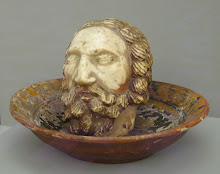
The choir processed down the main aisle of the darkened Dom, holding candles - yes! real lighted candles! - which provided most of the light for the whole evening, and once they were in position in front of the altar they sang the Lucia bride down the aisle on her own. This girl didn't get to sing very much as her job was to carry the blazing 7-candle gold crown on her head to the front of the choir and stand there - also holding a candle in her hands - while being serenaded by her choirmates for the first half of the concert. She was able to join the singing once the conductor finally lifted the crown off and laid it on a stand, where it continued to flame for the second half, making a weird candelabrum with definite medieval reliquary overtones. (But then, I had just been to see a fine collection of such medieval objects at the Kunstgewerbemuseum and was particularly alert to this echo.) The crown goes beyond a mere 4-candle Advent wreath - there are 6 long, thick candles around the head and one right on top. It is this last one, with its necessary curved cross-pieces meeting at the top of the head, that gave it the feel of something still inhabited while sitting on its own. I admit to having gotten a little worked up over the fate of that poor 15-year-old Sicilian girl while gazing at this illuminated headpiece, musing on her story and the terrible sufferings imposed by intolerance while listening to haunting music in the semi-dark. Fortunately for my public face I did not cry until I got home.
So, they sang carols in Swedish and German - all the music memorized - and moved around within the space a bit for variety. At one point they spread out through the cathedral and performed a song that morphed and shifted chords among their various positions, which must have been very difficult both to perform and to direct in such a darkened cavernous space. It was eerie and mystical, all those trained voices clear as bells in a cold winter night, right on cue although they could barely see their director. They reassembled, sang "Silent Night" while the Lucia bride was once again crowned with the still-burning candles. They serenaded her back down the aisle to "Santa Lucia" and then followed her out with subsequent verses. They could not be persuaded to do an encore. We tried.
I followed this with a second concert on Wednesday evening, also at the Dom. This was by the 10-piece brass choir "German Brass" and although the first half of the program focused on Bach and Handel it had much more the feel of a pops concert, which was a little jarring during the swingier numbers of the second half as they perform right at the marble altar with its crucifix front and center. I was also reminded why all brass, all evening, has not been something I seek out with regularity. Don't get me wrong, they did wonderful things with their instruments - sounded very like an organ on Bach's great Toccata and Fugue, like saxophones and almost like strings a time or two, superb musicians all. But as with any choir of like instruments, the texture and timbre of the sound has a certain constant, no matter the efforts to vary the voices, tempo and mood. It was a LOT of brass.
I bought a cheap ticket from a man selling his in the lobby, figuring that with a brass concert the location wouldn't be as important to me as it had been for the choir concert, for which I bought a good seat. Since the concert did not sell out, though, we lucky holders of the humble seats were moved into better ones, a real bargain, although I seem to be a magnet for people who insist on whispering during performances.
Of the pops numbers they performed, the most memorable was their first encore (they did two), a number I almost know but can't quite place, a rhythmic Latin tune with great trombone slides. The choir had comprised 4 trumpets, 3 trombones, 2 French horns, and a tuba; one of the horns also doubled as moderator, reciting a good bit of German doggerel to introduce each number in a most incomprehensible (to me) fashion. For the encore, however, all but two of them played trombone. After exiting to applause, a really large bass trombone (double bass? I know next to nothing about brass instruments) reappeared alone to begin the number. He was joined after a bit by a slightly smaller instrument who repeated the riff until a third and smaller one came out who repeated it again...and they kept coming and shrinking and playing until there were 8 trombones ranging in size from the large bass to one so tiny it looked like it could hang on a Christmas tree. They were like musical Matryushka dolls. (The other two musicians played maracas and guiro.) They were beautiful instruments, too, no doubt custom crafted for perfect sound. It was great fun, in spite of the crucifix.
I am off to my third Dom concert tomorrow, a late afternoon program of 17th century choral music. And then I hope to attend some at other venues, but it's hard to beat the Dom's offerings. However, St. Hedwig awaits, as does St. Marie and St. Nikolai so I will try and be generous with myself and make the rounds. So much music...
(As the name implies, this is a Chamber Choir from the music high school in Stockholm. It was begun in 1989 as an addition to the program for senior-level singers, a fact I note with mild interest, given the celebrations here this year commemorating reunification and the fall of the Wall, also in 1989.)
It was an entrancing evening, my first visit to the Berliner Dom, as I have been too cheap to pay the €5 admission just to look at yet another Baroque cathedral, especially one hailing from the 20th century and not one that Baroque composers such as Bach or Handel would ever have enchanted with their presence. And this one really is pretty much what its name implies - a huge dome sitting on its piers, enclosing an enormous unbroken interior space - no long, vaulted aisles or transept chapels - and without those peripheral spaces it is accoustically like sitting inside a huge bell. The music really rings.
St. Lucia became a biggie in Swedish lore although she was a Sicilian virgin martyr. (I researched the tradition once for a book I wrote for the Seattle Children's Museum; my younger daughter also did a report on this and I made her a Lucia outfit for her school presentation, although with fake candles. I consider myself fairly Lucia-friendly.) Lucia is celebrated as a 'bringer of light' on the darkest day of the year in one of the darkest parts of the world, and as a help during a terrible famine. Once when people were starving in Sweden, a boat filled with food was seen upon Lake Vannern, a woman at the helm with a glow about her head. She was recognized as Lucia because one of the other legends already circulating about her was that she took food to Christians hiding in the catacombs and in order to see her way through the tunnels she wore candles on her head. This early headlamp became her trademark and explains why the Swedish Lucia girl - or "bride" - wears a crown of candles as she takes her tray of coffee and buns around the neighborhood. There are enough versions of how Lucia lost her eyeballs - later miraculously restored, of course! - to fill a whole blog entry alone.
The choir - about 40 singers aged 16-19 - was dressed in full Lucia Day regalia: the girls wore long white gowns with red satin sashes, red and green twined garlands on their heads and the boys wore starboy outfits which only need ruffled collars and large black pompoms to double as costumes for a producion of Pagliacci. They are basically white pajamas and tall white pointed hats with varying degrees of decoration - star and moon cutouts and a few strands of tinsel for the most part. (It looked suspiciously as though the young men had made and decorated their own hats.) It was a little hard to take them seriously at first, looking like so many overgrown schoolboy dunces of another century, but their musicality more than made up for the initial distraction of this peculiar traditional garb.
The choir processed down the main aisle of the darkened Dom, holding candles - yes! real lighted candles! - which provided most of the light for the whole evening, and once they were in position in front of the altar they sang the Lucia bride down the aisle on her own. This girl didn't get to sing very much as her job was to carry the blazing 7-candle gold crown on her head to the front of the choir and stand there - also holding a candle in her hands - while being serenaded by her choirmates for the first half of the concert. She was able to join the singing once the conductor finally lifted the crown off and laid it on a stand, where it continued to flame for the second half, making a weird candelabrum with definite medieval reliquary overtones. (But then, I had just been to see a fine collection of such medieval objects at the Kunstgewerbemuseum and was particularly alert to this echo.) The crown goes beyond a mere 4-candle Advent wreath - there are 6 long, thick candles around the head and one right on top. It is this last one, with its necessary curved cross-pieces meeting at the top of the head, that gave it the feel of something still inhabited while sitting on its own. I admit to having gotten a little worked up over the fate of that poor 15-year-old Sicilian girl while gazing at this illuminated headpiece, musing on her story and the terrible sufferings imposed by intolerance while listening to haunting music in the semi-dark. Fortunately for my public face I did not cry until I got home.
So, they sang carols in Swedish and German - all the music memorized - and moved around within the space a bit for variety. At one point they spread out through the cathedral and performed a song that morphed and shifted chords among their various positions, which must have been very difficult both to perform and to direct in such a darkened cavernous space. It was eerie and mystical, all those trained voices clear as bells in a cold winter night, right on cue although they could barely see their director. They reassembled, sang "Silent Night" while the Lucia bride was once again crowned with the still-burning candles. They serenaded her back down the aisle to "Santa Lucia" and then followed her out with subsequent verses. They could not be persuaded to do an encore. We tried.
I followed this with a second concert on Wednesday evening, also at the Dom. This was by the 10-piece brass choir "German Brass" and although the first half of the program focused on Bach and Handel it had much more the feel of a pops concert, which was a little jarring during the swingier numbers of the second half as they perform right at the marble altar with its crucifix front and center. I was also reminded why all brass, all evening, has not been something I seek out with regularity. Don't get me wrong, they did wonderful things with their instruments - sounded very like an organ on Bach's great Toccata and Fugue, like saxophones and almost like strings a time or two, superb musicians all. But as with any choir of like instruments, the texture and timbre of the sound has a certain constant, no matter the efforts to vary the voices, tempo and mood. It was a LOT of brass.
I bought a cheap ticket from a man selling his in the lobby, figuring that with a brass concert the location wouldn't be as important to me as it had been for the choir concert, for which I bought a good seat. Since the concert did not sell out, though, we lucky holders of the humble seats were moved into better ones, a real bargain, although I seem to be a magnet for people who insist on whispering during performances.
Of the pops numbers they performed, the most memorable was their first encore (they did two), a number I almost know but can't quite place, a rhythmic Latin tune with great trombone slides. The choir had comprised 4 trumpets, 3 trombones, 2 French horns, and a tuba; one of the horns also doubled as moderator, reciting a good bit of German doggerel to introduce each number in a most incomprehensible (to me) fashion. For the encore, however, all but two of them played trombone. After exiting to applause, a really large bass trombone (double bass? I know next to nothing about brass instruments) reappeared alone to begin the number. He was joined after a bit by a slightly smaller instrument who repeated the riff until a third and smaller one came out who repeated it again...and they kept coming and shrinking and playing until there were 8 trombones ranging in size from the large bass to one so tiny it looked like it could hang on a Christmas tree. They were like musical Matryushka dolls. (The other two musicians played maracas and guiro.) They were beautiful instruments, too, no doubt custom crafted for perfect sound. It was great fun, in spite of the crucifix.
I am off to my third Dom concert tomorrow, a late afternoon program of 17th century choral music. And then I hope to attend some at other venues, but it's hard to beat the Dom's offerings. However, St. Hedwig awaits, as does St. Marie and St. Nikolai so I will try and be generous with myself and make the rounds. So much music...
Monday, December 7, 2009
Weihnachtsman is Coming to Town
Now that Christmas is looming, Berlin is filled with outdoor Christmas markets - Wiehnachtsmarkts - a six-week city-wide (region-wide) crafts fair and food fest, with ice rinks set up in the concrete plazas, even a sledding hill with a snow-making machine at one of them. There are pony rides, donkeys and reindeer to pet, sled-dogs who pull people in a wheeled contraption, children's trains, carousels, swings and huge ferris wheels, the kind with cabins instead of open bench seats. Think Vienna. Think "The Third Man". There are musicians, carolers, storytellers, nativity scenes, and giant-sized twirling wooden pyramids with carved figures going around and around in the breeze. As at home, the city trees are picked out in little white lights so it sparkles at night. Fortunately, there is not a single inflatable Frosty the Snowman to be seen.
The craft stalls range from hand-felted hats and slippers and amusing garlands of flowers to woodcarvings, jewelry, pottery and leather goods. In one, an Orthodox nun sells tacky reproductions of icons; in another is a blacksmith making iron hooks. There are Peruvians selling handknit sweaters and mittens and jewelry made from seashells. There are rows of patterned wax candles from Swaziland, soapstone items from Kenya, the ubiquitous wooden cats-on-chairs from Indonesia, eggshell mosaic bamboo bowls from Vietnam. My favorites are the few stalls run by individual craftspeople rather than the ones selling the mass-produced items, but even the mass-produced objects have a certain charm - the traditional German painted wooden ornaments and toys, the mechanical wind-up Santas and ducks, the beautiful leather gloves in more colors than I would ever need (but I covet every single one).
Being a collector, it is hard to pass up making a few purchases for myself, although I must be mindful of the eventual return trip home and the packing it will require. To make that a little less onerous, I am attempting to accumulate only small things, and to that end my Santa Claus collection now includes a tiny wooden Wiehnachtsman in a walnut shell case, and one in an impossibly tiny matchbox toyshop. I have also purchased a second walnut-shell piece, this one with a nativity scene and a tiny propeller on top to spin it around, to expand my over-the-top nacimiento display.
My favorite acquisition so far, however, is a nativity scene made in an old prayer book binding. I met the artist, an older gentleman from Austria, who uses tiny molds to make figures from ceramic clay, handpaints them all using a jeweler's loupe to help him see the fine detail work, and then constructs scenes of varying complexity, depending upon the size container he is using. He uses old boxes and books and shadowbox frames, mostly fairly small, but he has a huge one on display that must have hundreds of figures in it. In every single scene is the joyous "Jubelkarl", a goofy character from a 400-year-old Austrian tradition which I am still trying to decipher from the German handout I was given. Jubelkarl is apparently some sort of let's-look-on-the-bright-side of things Pollyanna, jolly no matter what the circumstances, and not associated with any particular holiday tradition. His presence in these nativities is completely whimsical. He wears 17th-century Austrian garb and is waving his hat about with happy abandon.
The markets are also crammed with the usual German food stands, with some other regional specialties thrown in, like Hungarian Langos - the eastern European answer to Indian frybread, served with sheep's cheese, tomatoes, sauce - and Dresdner Handbröt which requires an outside brick oven to bake the handmade bread stuffed with cheese to a melting wonder. There's wurst, potatoes in a dozen incarnations, huge pans of cooking mushrooms and onions, kraut and kale, flame-cooked salmon, goulash and soups, pasta, pizza, crepes, pastries, candies, and hot chocolate so thick you have to eat it with a spoon. My favorites are the nuts that are tumbled with a sugar mixture in a heated copper kettle until the sugar has cooked into a crunchy coating. Still warm from the vat they are excruciating. My dentist would be appalled at my consumption. The candy stalls also sell frosted gingerbread heart cookies of varying sizes (some of them must be 18" across) that are strung with ribbons and worn around the neck, and another newbie to me, the Schaumküsse, which are fluffy cylinders of lightly flavored delicate marshmallow cream dipped in a variety of chocolate coatings. (Can you tell by my loving description that I have also consumed several of these?) There is also, of course, beer. And Glühwein; everywhere Glühwein. (The German word for lightbulb is "Glühlampe"; I'm not sure if the warm spiced wine derives its similarly glowing name from the effect it has on its consumers - perhaps the glowing feelings it bestows, or the eventual transformation of those drinkers' noses from mere prosaic fleshy extrusions into something more incandescent. I may never know.)
So far I have no plans for Christmas myself. With the dollar continuing to drop against the Euro, an expedition to Crete is probably not in the cards. I thought about Mallorca as it's super-cheap to get there, but with Hannah gone I would have to board Maggie, which doesn't seem like it's in the cards, either. I am scoping out the Christmas concert scene and plan at least to get to a musical event or two, and will possibly go to Christmas dinner and a movie with an American friend from the Goethe Institute who is also familyless here. In any event, it's Christmas in Europe! What's not to love?
The craft stalls range from hand-felted hats and slippers and amusing garlands of flowers to woodcarvings, jewelry, pottery and leather goods. In one, an Orthodox nun sells tacky reproductions of icons; in another is a blacksmith making iron hooks. There are Peruvians selling handknit sweaters and mittens and jewelry made from seashells. There are rows of patterned wax candles from Swaziland, soapstone items from Kenya, the ubiquitous wooden cats-on-chairs from Indonesia, eggshell mosaic bamboo bowls from Vietnam. My favorites are the few stalls run by individual craftspeople rather than the ones selling the mass-produced items, but even the mass-produced objects have a certain charm - the traditional German painted wooden ornaments and toys, the mechanical wind-up Santas and ducks, the beautiful leather gloves in more colors than I would ever need (but I covet every single one).
Being a collector, it is hard to pass up making a few purchases for myself, although I must be mindful of the eventual return trip home and the packing it will require. To make that a little less onerous, I am attempting to accumulate only small things, and to that end my Santa Claus collection now includes a tiny wooden Wiehnachtsman in a walnut shell case, and one in an impossibly tiny matchbox toyshop. I have also purchased a second walnut-shell piece, this one with a nativity scene and a tiny propeller on top to spin it around, to expand my over-the-top nacimiento display.
My favorite acquisition so far, however, is a nativity scene made in an old prayer book binding. I met the artist, an older gentleman from Austria, who uses tiny molds to make figures from ceramic clay, handpaints them all using a jeweler's loupe to help him see the fine detail work, and then constructs scenes of varying complexity, depending upon the size container he is using. He uses old boxes and books and shadowbox frames, mostly fairly small, but he has a huge one on display that must have hundreds of figures in it. In every single scene is the joyous "Jubelkarl", a goofy character from a 400-year-old Austrian tradition which I am still trying to decipher from the German handout I was given. Jubelkarl is apparently some sort of let's-look-on-the-bright-side of things Pollyanna, jolly no matter what the circumstances, and not associated with any particular holiday tradition. His presence in these nativities is completely whimsical. He wears 17th-century Austrian garb and is waving his hat about with happy abandon.
The markets are also crammed with the usual German food stands, with some other regional specialties thrown in, like Hungarian Langos - the eastern European answer to Indian frybread, served with sheep's cheese, tomatoes, sauce - and Dresdner Handbröt which requires an outside brick oven to bake the handmade bread stuffed with cheese to a melting wonder. There's wurst, potatoes in a dozen incarnations, huge pans of cooking mushrooms and onions, kraut and kale, flame-cooked salmon, goulash and soups, pasta, pizza, crepes, pastries, candies, and hot chocolate so thick you have to eat it with a spoon. My favorites are the nuts that are tumbled with a sugar mixture in a heated copper kettle until the sugar has cooked into a crunchy coating. Still warm from the vat they are excruciating. My dentist would be appalled at my consumption. The candy stalls also sell frosted gingerbread heart cookies of varying sizes (some of them must be 18" across) that are strung with ribbons and worn around the neck, and another newbie to me, the Schaumküsse, which are fluffy cylinders of lightly flavored delicate marshmallow cream dipped in a variety of chocolate coatings. (Can you tell by my loving description that I have also consumed several of these?) There is also, of course, beer. And Glühwein; everywhere Glühwein. (The German word for lightbulb is "Glühlampe"; I'm not sure if the warm spiced wine derives its similarly glowing name from the effect it has on its consumers - perhaps the glowing feelings it bestows, or the eventual transformation of those drinkers' noses from mere prosaic fleshy extrusions into something more incandescent. I may never know.)
So far I have no plans for Christmas myself. With the dollar continuing to drop against the Euro, an expedition to Crete is probably not in the cards. I thought about Mallorca as it's super-cheap to get there, but with Hannah gone I would have to board Maggie, which doesn't seem like it's in the cards, either. I am scoping out the Christmas concert scene and plan at least to get to a musical event or two, and will possibly go to Christmas dinner and a movie with an American friend from the Goethe Institute who is also familyless here. In any event, it's Christmas in Europe! What's not to love?
Tuesday, November 17, 2009
And Now a Word about Maggie
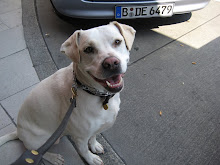
I am greatly relieved to know that German dog names are every bit as stupid as American ones. We go to the dog park daily, where Maggie romps with an enormous assortment of beasts, some on a consistent enough basis to be getting to know their names and personalities. There is a French bulldog named Anton with a large wen above his left eye, an 8-month-old Great Dane puppy named Ludwig (who stands as high as what remains of my chest), several chocolate Labs named Oskar, a few diminutive no-breed Betties, a Bernese Mountain dog named Donna (Donna!) who barks at me, a Jack Russell terrier named Cesar, and another silly big mutt named Travis (but pronounced Trevvis), who is easily subdued by the Jack Russell terrier named Leo. There's a Tyler, a Lola, a Leila, a Fraulein, a Helmut, a Spike, a Boomer and a Martini. A puggle puppy named Fattska. An ancient Rottweiler named Bruno. Another indeterminate brindle mix named Bones. There are no fewer than FIVE dogs named Keira, one of whom is a Weimaraner who prances obsessively in circles and figure-eights with a soccer ball clamped firmly in her mouth. That is, when she's not chewing on rocks or paving stones. Sputnik's owner has been told by Russians that Sputnik is NOT a good name for a female dog; Maximilian is a shepherd mix who has dug a hole so far under a tree all that shows is his rear end and wagging tail when he's in it, sniffing for treasure.
Maggie is particularly attentive to the two entry gates, continually watching for newcomers, as she gets bored quickly sniffing the same old posteriors. She runs with each new arrival - madly - for about 30 seconds and then putzes around on her own until the next novelty turns up. Sometimes it's not a newcomer at all but a scuffle between kids already on the playground and Maggie is quick to present herself for consultation on how best to resolve the difficulty. Of course, the others all speak German so her suggestions fall on deaf ears. Large, floppy ears, for the most part.
I have spoken to a few other dog owners during these daily excursions, but I don't have good chit-chat German and cannot maintain much of a conversation yet, beyond asking name, age and breed. One friend I have made, however, is a very nice hockey player-turned sports-psychologist, a native from Munich who lived in Spokane for a while, playing hockey for the Chiefs. He's the only person I've met here (not that there have been many) who's even heard of Spokane, let alone Walla Walla. And he speaks very good English. He belongs to old Klara, who became permanently bonded with me one day when I gave her a dog treat for sitting so nicely when I told her to.
Maggie is particularly attentive to the two entry gates, continually watching for newcomers, as she gets bored quickly sniffing the same old posteriors. She runs with each new arrival - madly - for about 30 seconds and then putzes around on her own until the next novelty turns up. Sometimes it's not a newcomer at all but a scuffle between kids already on the playground and Maggie is quick to present herself for consultation on how best to resolve the difficulty. Of course, the others all speak German so her suggestions fall on deaf ears. Large, floppy ears, for the most part.
I have spoken to a few other dog owners during these daily excursions, but I don't have good chit-chat German and cannot maintain much of a conversation yet, beyond asking name, age and breed. One friend I have made, however, is a very nice hockey player-turned sports-psychologist, a native from Munich who lived in Spokane for a while, playing hockey for the Chiefs. He's the only person I've met here (not that there have been many) who's even heard of Spokane, let alone Walla Walla. And he speaks very good English. He belongs to old Klara, who became permanently bonded with me one day when I gave her a dog treat for sitting so nicely when I told her to.
Wall Fall Down
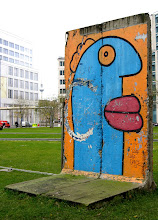
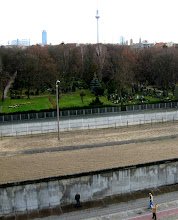
Monday, November 9, was Fall of the Wall day, the 20th anniversary of the breaching of the divisive behemoth that kept half Berlin prisoner for 30 years; not news to anyone, but an interesting day to be here.
It was an odd choice of date, to my thinking, being the same as the ghastly Kristallnacht in 1938.
It was also a kind of odd event, seemingly geared mostly to media and tourists, with the average Berliners somewhat unconcerned and going about their daily business as usual. Their big holiday was on Saturday, October 3, when businesses were closed for the celebration of German Reunification (with the French puppets...), so maybe they were sated with festivities. It's surprising to me that polls, as reported in the New York Times, show that there are still Germans, both east and westerners, who preferred the old, divided system, by some accounts as many as 1 in 8. There were certainly plenty of people who turned out for the day's "Festival of Freedom" but I didn't sense a particularly excited buzz anywhere. It was also an unfortunately cold and rainy day.
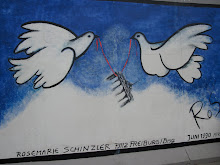
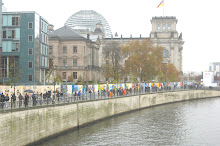
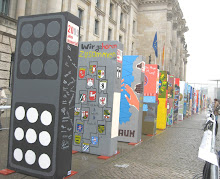
I spent the first part of that morning getting my one-year visa at the Ausländerbehörde, a somewhat humiliating adventure in German bureaucratese (as if German isn't hard enough to begin with!), and then wandered to the Brandenburg Gate and Pariser Platz to scrutinize the 1.5 kilometers of huge painted "dominoes" that were poised and waiting for Lech Walesa to push them into a second "Mauerfall" late in the afternoon. They were reminiscent of school and community projects everywhere, created mainly by kids but with a few by "real artists" thrown in for good measure and credibility, I suppose. It was outstanding mainly for the scope and range of the exhibit - laid out with German precision - which began at the far end of the Holocaust Memorial, ran straight past the U.S. Embassy, the Brandenburg Gate and Reichstag, and curved sharply several times to travel along the river, across a bridge, and into the final stretch along the opposite riverbank. There were few notable pieces of art involved, although there was an exceedingly funny one, obviously done by kids. One one side it depicted a happy couple at the beach, standing on the sand in their swimsuits, waving to the viewer. There were written instructions to look at the other side, where the same couple appeared in the same pose, this time in full frontal nudity.
There were some school groups out while I was there but they appeared to be kids whose school or class had painted one of these thousand dominoes. Many of them were dressed in official participant T-shirts or silver jackets, the jacketed ones being allowed inside the protective barricades to stand with their own projects. One security guard became enraged at a few of them, however, for playing hide and seek around the artworks, no doubt paranoid that the entire event would be ruined on his watch by the accidental triggering of the cascade of monoliths. The kids appeared to have the fear of God put into them and Lech got to do his thing, so the guy was at least successful in preserving the day's climax until the appointed time.
For some inexplicable reason, Jon Bon Jovi was the headline entertainment. Daniel Barenboim at least had the good sense to conduct a program of the Staatskapelle and Staatsopernchor by German composers in the tent specially constructed for this outdoor event; what Bon Jovi has to do with ANYTHING is beyond me. At the very least I would have thought they'd choose Peter Fox if they needed a pop star to get people's attention. A German; a Berliner perhaps? Maybe Peter was on tour. But wasn't Barenboim enough???
I didn't hang around for the speechifying, music and evening fireworks. I had enough of a crowd encounter on Reunification Day. Hillary, Angela, Mikhail, Lech and the gang seemed to pull it all off without a hitch, and without any help from me.
It was an odd choice of date, to my thinking, being the same as the ghastly Kristallnacht in 1938.
It was also a kind of odd event, seemingly geared mostly to media and tourists, with the average Berliners somewhat unconcerned and going about their daily business as usual. Their big holiday was on Saturday, October 3, when businesses were closed for the celebration of German Reunification (with the French puppets...), so maybe they were sated with festivities. It's surprising to me that polls, as reported in the New York Times, show that there are still Germans, both east and westerners, who preferred the old, divided system, by some accounts as many as 1 in 8. There were certainly plenty of people who turned out for the day's "Festival of Freedom" but I didn't sense a particularly excited buzz anywhere. It was also an unfortunately cold and rainy day.
I spent the first part of that morning getting my one-year visa at the Ausländerbehörde, a somewhat humiliating adventure in German bureaucratese (as if German isn't hard enough to begin with!), and then wandered to the Brandenburg Gate and Pariser Platz to scrutinize the 1.5 kilometers of huge painted "dominoes" that were poised and waiting for Lech Walesa to push them into a second "Mauerfall" late in the afternoon. They were reminiscent of school and community projects everywhere, created mainly by kids but with a few by "real artists" thrown in for good measure and credibility, I suppose. It was outstanding mainly for the scope and range of the exhibit - laid out with German precision - which began at the far end of the Holocaust Memorial, ran straight past the U.S. Embassy, the Brandenburg Gate and Reichstag, and curved sharply several times to travel along the river, across a bridge, and into the final stretch along the opposite riverbank. There were few notable pieces of art involved, although there was an exceedingly funny one, obviously done by kids. One one side it depicted a happy couple at the beach, standing on the sand in their swimsuits, waving to the viewer. There were written instructions to look at the other side, where the same couple appeared in the same pose, this time in full frontal nudity.
There were some school groups out while I was there but they appeared to be kids whose school or class had painted one of these thousand dominoes. Many of them were dressed in official participant T-shirts or silver jackets, the jacketed ones being allowed inside the protective barricades to stand with their own projects. One security guard became enraged at a few of them, however, for playing hide and seek around the artworks, no doubt paranoid that the entire event would be ruined on his watch by the accidental triggering of the cascade of monoliths. The kids appeared to have the fear of God put into them and Lech got to do his thing, so the guy was at least successful in preserving the day's climax until the appointed time.
For some inexplicable reason, Jon Bon Jovi was the headline entertainment. Daniel Barenboim at least had the good sense to conduct a program of the Staatskapelle and Staatsopernchor by German composers in the tent specially constructed for this outdoor event; what Bon Jovi has to do with ANYTHING is beyond me. At the very least I would have thought they'd choose Peter Fox if they needed a pop star to get people's attention. A German; a Berliner perhaps? Maybe Peter was on tour. But wasn't Barenboim enough???
I didn't hang around for the speechifying, music and evening fireworks. I had enough of a crowd encounter on Reunification Day. Hillary, Angela, Mikhail, Lech and the gang seemed to pull it all off without a hitch, and without any help from me.
Tuesday, November 3, 2009
Holidays
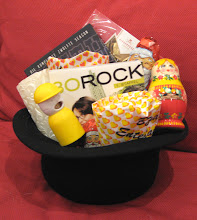
Halloween has come to Germany, well, sort of, and last weekend Hannah had a very well attended costume party for which I helped decorate. I brought a number of "Helloween" pumpkins (according to the sign at my grocery store) which we carved, cut out paper skulls and bats, and draped a few wisps of fake spiderweb around. I dressed as Pope Gregory VII, about whom Hannah had that day turned in a paper she had been working on for 6 months; I thought it only fitting to come as her worst nightmare. I was rather pleased with the effect I achieved with a large gold gift bag and a white tablecloth.
Next up is Thanksgiving. My brothers and sisters-in-law are all coming and Hannah and I are planning a full American event at her apartment, with turkey, stuffing, potatoes, gravy, Brussels sprouts and my family's one culinary heirloom, Cranberry Ice, which I will concoct and then transport on the tram, arriving at Hannah's with a very cold lap, indeed. We have invited a number of American friends as well as the fam, and as Hannah is still a little short on furniture some of us may end up sitting on the floor. With that in mind I will leave the dog at home, for which everyone will be very thankful.
For Christmas I was thinking of going to Crete, as Hannah will be traveling home this year to attend an important wedding, and I had visions of myself being alone and homesick in an atmosphere of Dickensian revelry and White Christmas sentimentality in a city that looks so much like "home." I figured Crete would be foreign enough to conjure few associations for me and keep me almost blissfully unaware of Christmas at all. Now, however, I think I will just stay put and take the trip to Crete later with Hannah, as my Christmas present to both of us, and find some ingenious way of coping with the holiday and all its reminders. Too bad the museums won't be open.
Next up is Thanksgiving. My brothers and sisters-in-law are all coming and Hannah and I are planning a full American event at her apartment, with turkey, stuffing, potatoes, gravy, Brussels sprouts and my family's one culinary heirloom, Cranberry Ice, which I will concoct and then transport on the tram, arriving at Hannah's with a very cold lap, indeed. We have invited a number of American friends as well as the fam, and as Hannah is still a little short on furniture some of us may end up sitting on the floor. With that in mind I will leave the dog at home, for which everyone will be very thankful.
For Christmas I was thinking of going to Crete, as Hannah will be traveling home this year to attend an important wedding, and I had visions of myself being alone and homesick in an atmosphere of Dickensian revelry and White Christmas sentimentality in a city that looks so much like "home." I figured Crete would be foreign enough to conjure few associations for me and keep me almost blissfully unaware of Christmas at all. Now, however, I think I will just stay put and take the trip to Crete later with Hannah, as my Christmas present to both of us, and find some ingenious way of coping with the holiday and all its reminders. Too bad the museums won't be open.
Blogged Down II
My blogging pace has certainly slowed down with my settling into life here. My routines are now not unlike what they were at home, just a few thousand miles away and with a serious sausage flavor. I get up, let the dog out, make coffee, put the couch together, eat some breakfast, feed the dog, write for an hour, shower, dress, paint or read for a while, make lunch, take the dog to the dog park, do some shopping, write some emails, have some skype chats, make dinner, do the dishes, feed the dog, paint a little, read some more, fold out the bed, let the dog out, read in bed, and sleep. I might throw in an afternoon nap, too, if my morning reading has been particularly exhausting. On Sundays I do laundry and go to flea markets, but these are beginning to lose their novelty and blur into one big, slightly foreign yard sale, with a lot of old record albums, electrical cords and plastic egg cups on display. I did buy a mirror one weekend, however.
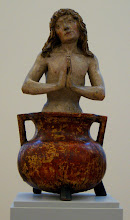
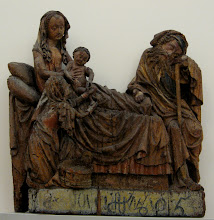
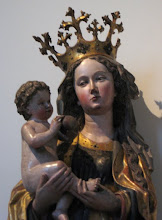
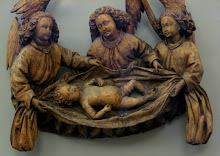
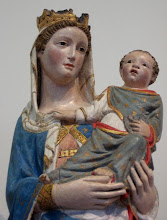
A lot of the museums are open on Sunday, and are likely to serve as replacement outings for the flea markets. Today I bought a year pass for the cluster that is run by the Stadt of Berlin, so I can just pop into any of them I choose when I am out and about. I spent a part of the afternoon today at the Bode, in the medieval sculpture rooms mostly, until I got saturated with the lushly carved wooden drapery and gilded robes of saints and martyrs, the bland and beatific features of countless Virgins and their orb-headed infants, and began to be disturbed by the violent gestures and grisly allusions animating so much of Christian art. And so to lunch in the museum cafe and a browse in the bookstore, where I found a good book in English on the art and architecture of Berlin. An excellent find. And an excellent museum in a stunning building. I look forward to more curious wandering among the plinths and vitrines.
I had coffee later in the day with a new German friend, our first meeting as Tandem partners - she helps me with my German and I help her with her English - but we spent the whole time auf Deutsch with me struggling both to say what I wanted to say and understand what she said in return. We laughed a lot. I think I am more motivated to work on my German than she is on her English, which works well for me, although my motivation does not extend to doing much study on my own at home, which would help a lot... Next week we will go to a museum together, perhaps the Neues Museum to gape at the newly returned Nefertiti, who has not been on view there in 70 years. Egypt keeps trying to get her back but I don't think they'll ever succeed. Berlin has too strong a hold on her. It is developing a strong hold on me, too.
A lot of the museums are open on Sunday, and are likely to serve as replacement outings for the flea markets. Today I bought a year pass for the cluster that is run by the Stadt of Berlin, so I can just pop into any of them I choose when I am out and about. I spent a part of the afternoon today at the Bode, in the medieval sculpture rooms mostly, until I got saturated with the lushly carved wooden drapery and gilded robes of saints and martyrs, the bland and beatific features of countless Virgins and their orb-headed infants, and began to be disturbed by the violent gestures and grisly allusions animating so much of Christian art. And so to lunch in the museum cafe and a browse in the bookstore, where I found a good book in English on the art and architecture of Berlin. An excellent find. And an excellent museum in a stunning building. I look forward to more curious wandering among the plinths and vitrines.
I had coffee later in the day with a new German friend, our first meeting as Tandem partners - she helps me with my German and I help her with her English - but we spent the whole time auf Deutsch with me struggling both to say what I wanted to say and understand what she said in return. We laughed a lot. I think I am more motivated to work on my German than she is on her English, which works well for me, although my motivation does not extend to doing much study on my own at home, which would help a lot... Next week we will go to a museum together, perhaps the Neues Museum to gape at the newly returned Nefertiti, who has not been on view there in 70 years. Egypt keeps trying to get her back but I don't think they'll ever succeed. Berlin has too strong a hold on her. It is developing a strong hold on me, too.
Subscribe to:
Posts (Atom)